

Pressure washing, power washing & concrete
Pressure Washing in St. Louis — Driveways, Concrete, Patios and Decks
We pressure wash the surfaces that should be pressure washed — concrete, pavers, hard flatwork — and soft wash the ones that should not, like roofs and siding. Driveways and walks are cleaned with a surface cleaner, so you get an even slab instead of the zebra striping a hand wand leaves behind.
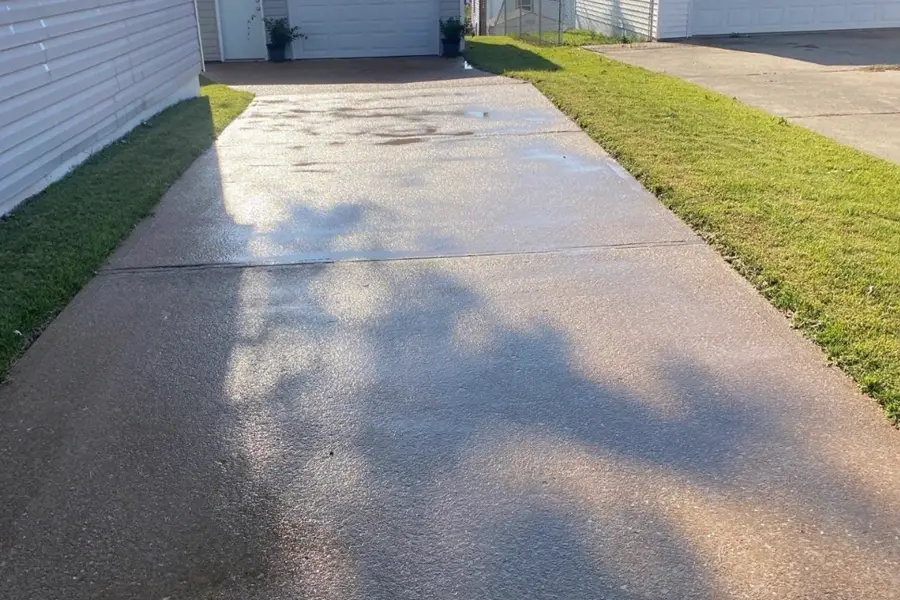
"Pressure washing" and "power washing" — what people mean
Most people searching for either one just want the outside of their property cleaned. The technical distinction is only that power washing heats the water and pressure washing does not, and heat mainly matters on grease.
The distinction that actually affects your property is pressure versus low pressure — and which one belongs on which surface.
Which method your surface needs
- Pressure, with a surface cleaner: concrete driveways, sidewalks, patios, brick pavers, pool decks, garage floors, commercial flatwork.
- Low-pressure soft wash: roofs, vinyl and Hardie siding, stucco and EIFS, brick walls, painted wood, soffit and fascia, screens, fences, most decks.
Using pressure on the second list is how people end up with pitted stucco, stripped paint, eroded mortar and water inside a wall. There is a longer version of that argument in soft washing vs pressure washing.
What we clean
Driveways, sidewalks and patios
Cleaned with a surface cleaner, which covers the full width of each pass at consistent pressure so you get an even slab rather than overlapping arcs. Edges and transitions are detailed by hand.
Brick pavers and stamped concrete
Reduced pressure. Pavers lose joint sand if you hit them too hard, and stamped or colored concrete has a surface finish that strips. Both clean well when the pressure is dialled for the material.
Decks and fences
Wood is softer than most people assume. A pressure washer raises the grain and leaves permanent wand marks across the boards. We clean wood at low pressure with a solution that lifts the grey weathering and the mildew growing in the grain — which also leaves the surface ready for stain.
Gutters, inside and out
Clearing the trough is one job; the black vertical staining on the gutter face is another, and it needs a separate brightening step. We can do either or both.
Commercial flatwork
Dumpster pads, drive-throughs, entryways, loading areas and parking structures — see commercial exterior cleaning.
Pressure washing questions
What people ask before booking
Do you do pressure washing, or only soft washing?
Both. We match the method to the surface.
Concrete, brick pavers and hard flatwork get pressure — specifically a surface cleaner, which is a rotating-bar attachment that covers the slab evenly. Roofs, siding, stucco and painted wood get a low-pressure soft wash instead, because pressure damages those surfaces.
Anyone who tells you one method handles every surface is selling you the equipment they own.
What is the difference between pressure washing and power washing?
Power washing heats the water. Pressure washing does not. Beyond that they are the same process, and in everyday use the two words mean the same thing to almost everyone.
Heat helps on grease — restaurant pads, drive-throughs, oil-stained concrete. On general exterior grime it makes very little difference.
Why does concrete end up with stripes after cleaning?
Because it was cleaned with a hand wand instead of a surface cleaner. A wand cleans in an arc, and where the arcs overlap you get a lighter band — the "zebra striping" you see on a lot of driveways.
A surface cleaner applies even coverage across the whole width of the pass, so the slab comes out uniform.
Will pressure washing remove oil stains from my driveway?
Sometimes, and we will not promise it. Fresh oil usually lifts with a degreaser and hot water. Oil that has been soaking into porous concrete for years has penetrated below the surface, and nothing short of resurfacing fully removes it.
We will tell you what we realistically expect before we start rather than after.
Can you clean pavers and stamped concrete?
Yes, at reduced pressure. Pavers clean well but aggressive pressure blows the joint sand out, which then has to be replaced. Stamped and colored concrete has a surface treatment that high pressure will strip.
Tell us which you have when you request an estimate.
How often should concrete be cleaned?
Every one to two years for most driveways and walks in St. Louis County.
Shaded concrete and anything under trees grows algae faster and gets slick — that is a safety issue as much as an appearance one. Pool decks and pool surrounds are usually annual.
Get your concrete and exterior cleaned
Tell us what needs doing. We will price it honestly and use the method the surface actually calls for.