
Roof cleaning & roof washing
Roof Cleaning in St. Louis — Remove Black Streaks Without Damaging Shingles
Those black streaks are algae, not dirt, and the safe way off an asphalt roof is low-pressure soft washing — not pressure washing. We apply a solution that kills the organism at the root, rinse at about garden-hose pressure, and leave the shingle granules where they belong.
One of our roofs
A St. Louis-metro roof, washed in a single morning
Same roof, same vantage point, same day. The times below are the camera's, not ours.
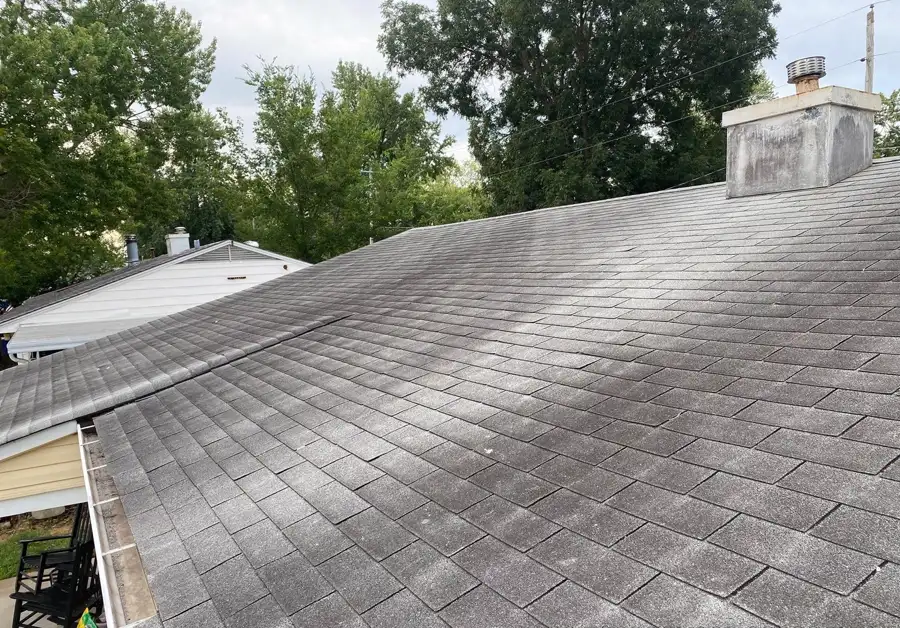
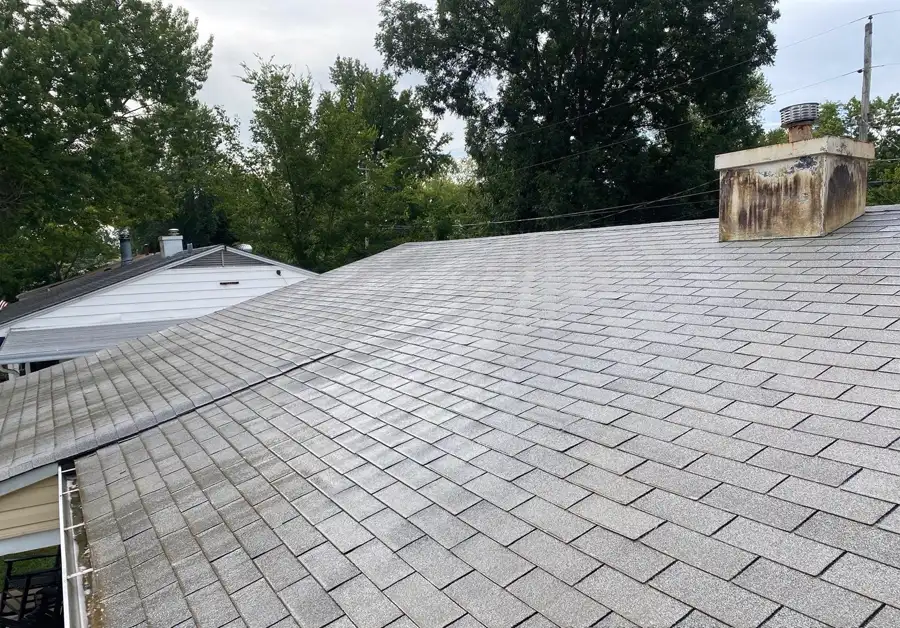
Roofs carry on lightening for days after the wash as rain rinses the dead algae away. This is the same morning — not the finished result weeks later.
What the black streaking actually is
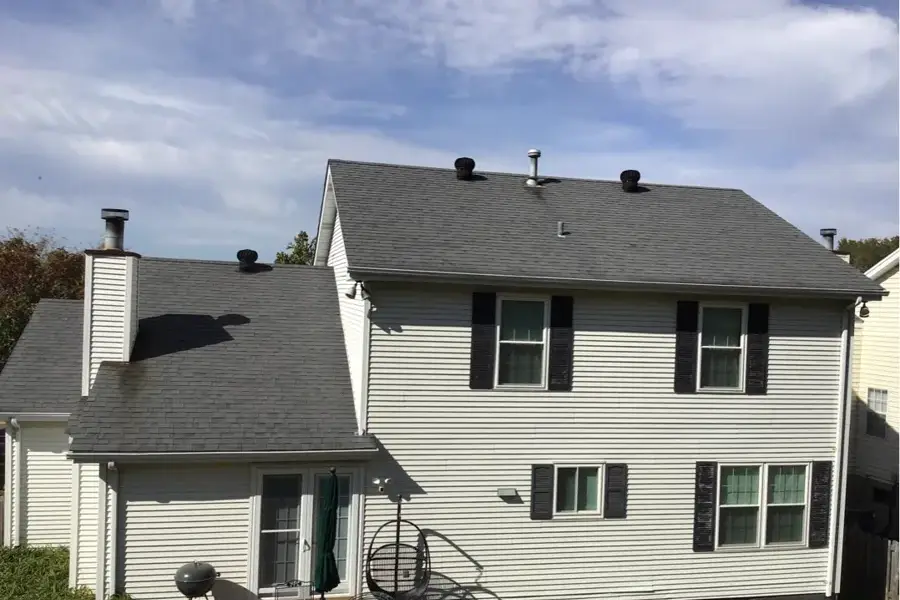
It is a blue-green algae, Gloeocapsa magma. It arrives airborne, lands on the roof and feeds on the limestone filler manufacturers blend into asphalt shingles. As it colonises, it forms a dark protective sheath — that is the black you see. Rain carries spores down the slope, which is why the stain runs in streaks rather than patches.
Two things make St. Louis roofs a good host: humidity through the summer, and mature tree cover across most of the county. North-facing slopes hold moisture the longest and almost always stain first.
It matters beyond looks. A dark algae layer absorbs heat the shingle was designed to reflect, and moss and lichen growing alongside it hold water against the roof deck.
Why we will not pressure wash your roof
A pressure washer will absolutely remove the black. It will also remove the granules — the ceramic layer bonded to the shingle that takes the UV hit and the weather so the asphalt underneath does not. Strip those and the shingle ages fast.
High pressure aimed up a slope can also push water under the shingle course and into the decking, and it can break the seal between courses that keeps the roof watertight in wind.
This is not a niche opinion. Shingle manufacturers and the Asphalt Roofing Manufacturers Association both point homeowners to low-pressure cleaning, and pressure washing a roof can void a shingle warranty. If you want the two methods side by side, we wrote that up in soft washing vs pressure washing.
What a soft wash actually involves
- We look at the roof first. Pitch, shingle type and condition, how much lichen is present, where the water runs off and what is planted underneath.
- Landscaping gets protected. Plants and shrubs below the work area are saturated with water before we start and kept wet throughout — this is the Good Stewards part of the process.
- Solution is applied at low pressure. Roughly garden-hose pressure, worked from the appropriate access point, covering the full slope rather than spot-treating the worst streaks.
- It dwells, then it is rinsed. The organism dies during the dwell. Rinsing carries the bulk of it off.
- Everything below gets rinsed down. Landscaping, siding, walks and drive.
Expect the roof to keep lightening for days to weeks afterward as rain finishes rinsing the dead growth away. That is the process working, not an incomplete job.
Roof types we clean
- Asphalt and architectural shingle — the large majority of St. Louis County roofs.
- Metal — standing seam and corrugated, including painted finishes.
- Concrete and clay tile — low pressure only; tile is brittle at the edges and walking it wrong breaks it.
- Cedar shake — different solution strength, and never high pressure.
- Flat and low-slope commercial — TPO, EPDM and modified bitumen.
Gutters, soffit and fascia are usually cleaned in the same visit, because the runoff from a roof wash hits them anyway.
Roof cleaning questions
What homeowners ask before booking
Why are there black streaks on my roof in St. Louis?
The streaks are a blue-green algae called Gloeocapsa magma, not dirt. It feeds on the limestone filler used in asphalt shingles and spreads downhill with rainfall, which is why the staining runs in vertical streaks.
St. Louis gives it everything it wants: humid summers, wet springs and heavy tree cover. North-facing slopes stain first because they stay damp longest.
Is it safe to pressure wash a roof?
No. High pressure strips the ceramic granules that shield asphalt shingles from UV, and it can drive water up under the shingle course. Both shorten the life of the roof.
The Asphalt Roofing Manufacturers Association and shingle manufacturers direct homeowners to low-pressure cleaning for this reason. Pressure washing a roof can also void a shingle warranty.
Will roof cleaning damage my shingles?
A correctly performed soft wash does not. There is no mechanical force against the shingle, so nothing scrubs the granules loose.
The real risk in roof cleaning is chemical — the wrong concentration, letting solution dry on the surface, or skipping landscape protection. That is what certification and a specified process are for.
How long does roof cleaning last?
Typically several years, because the algae is killed rather than knocked off.
How long depends on your roof. Heavy shade, overhanging limbs and a north-facing slope will regrow sooner than an open, sunny roof. Trimming branches back off the roof is the single cheapest thing you can do to extend it.
Do the streaks come off immediately?
Most of the discoloration lifts during the wash; the rest fades over the following days and weeks as rain rinses the dead organism off.
A roof that has been stained for years may keep improving for a month. That is normal and it is a sign the treatment worked rather than just wetting the surface.
What time of year is best to clean a roof in St. Louis?
Anytime the temperature is reliably above freezing — so roughly March through November here.
Spring and early fall are the most comfortable windows. There is no need to wait for a particular season; algae grows through the whole warm half of the year.
Can you clean moss and lichen too?
Yes, though lichen behaves differently from algae. Algae is surface growth and clears relatively quickly. Lichen roots into the shingle and moss holds moisture against it.
Both are treated at low pressure and both continue releasing over the weeks after the wash. Scraping or pressure-blasting lichen takes shingle material with it.
Do you clean metal, tile and cedar roofs?
Yes. Metal, concrete tile and cedar shake all clean at low pressure, and each needs a different solution strength and dwell time. Tell us the roof type when you request an estimate so we bring the right setup.
Find out what your roof costs to clean
Send us the address and the roof type. We will get you a real number — and if a soft wash is not the right call for your roof, we will tell you that instead.